How does SFT shape tool use during RL?
In tool-integrated reasoning, a model can answer a question directly or use a tool along the way. Here it can crop and enlarge part of an image with Zoom, or run a Python calculation with Code. After each call, the model sees the result and continues. We call the reasoning immediately before each call pre-call reasoning.
We ask how the demonstrations used for supervised fine-tuning (SFT) shape the tool-use behaviors that survive reinforcement learning (RL). We start with the same model, Qwen2.5-VL-7B-Instruct, and vary the number of calls in its demonstrations.
Among demonstrations that use a tool, Low examples make one call, Medium two or three, and High four or more. Each set has 2,000 demonstrations, with the same proportions of Zoom, Code and direct answers and similar supervision budgets.
Each model receives the same questions and 32 updates of GRPO. The reward depends only on whether the final answer is correct. The model decides when to call a tool.
Divergent tool use under identical RL training
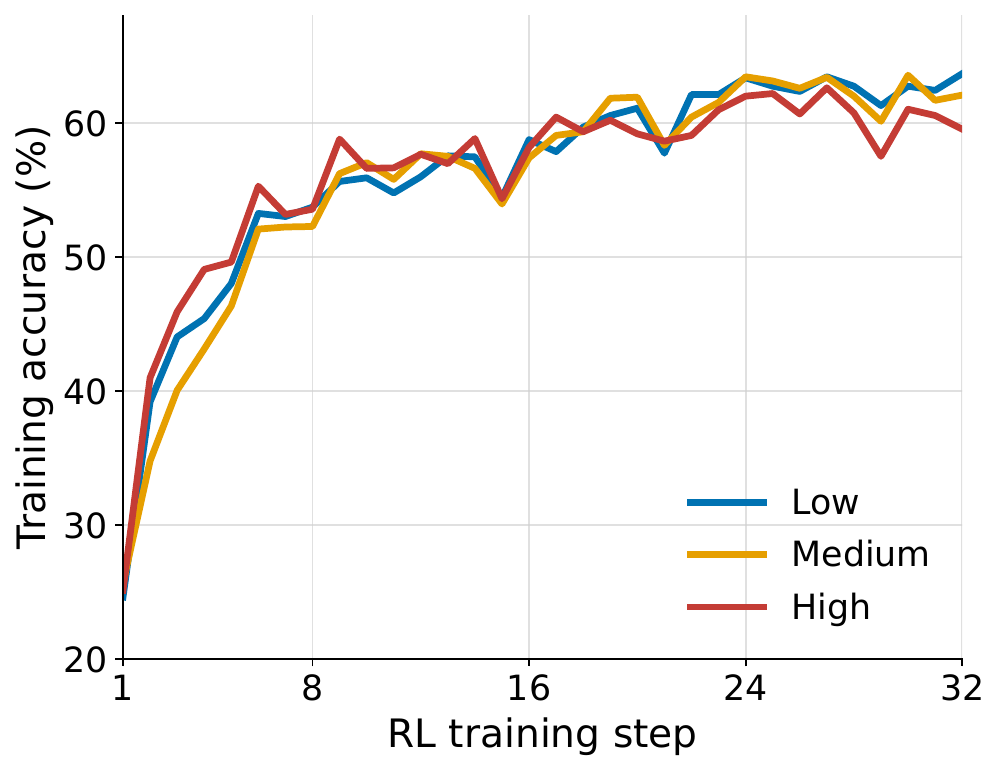
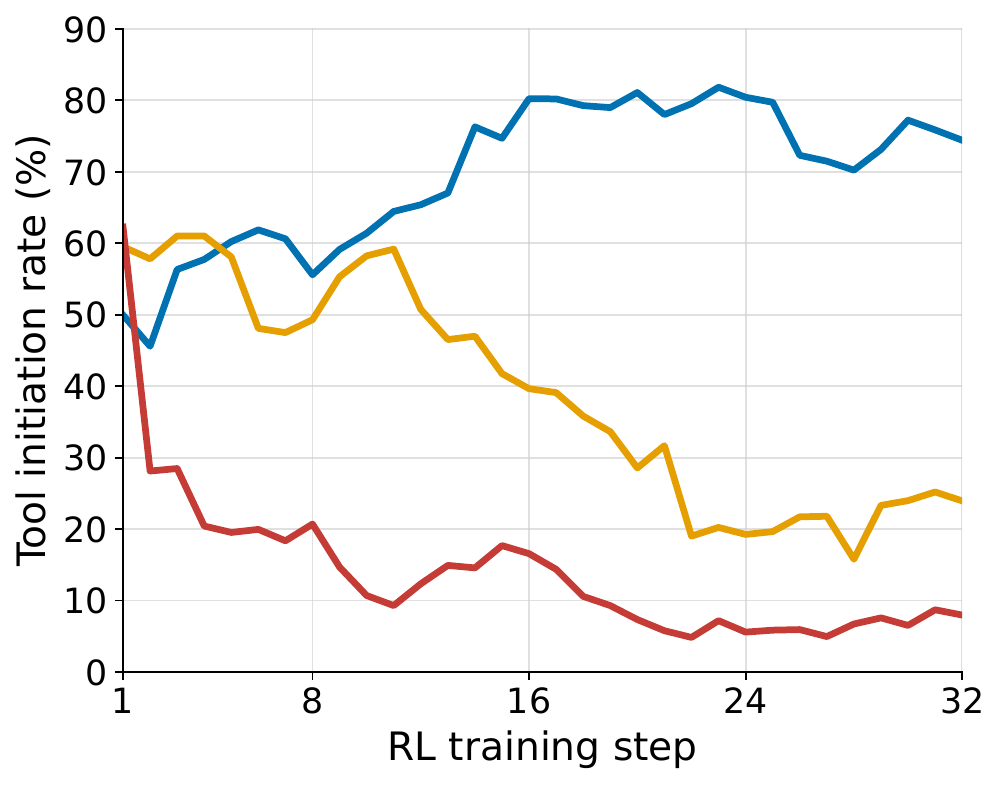
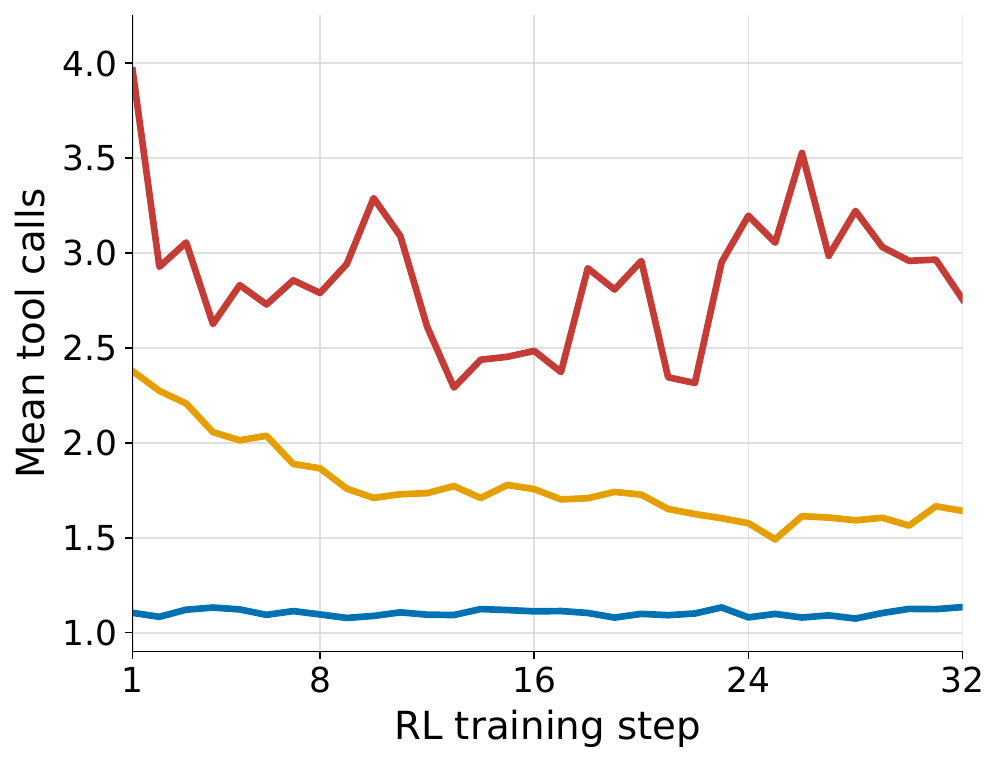
The three models reach similar training accuracy. Their tool use takes different paths. Low continues to use tools frequently, while High becomes the least likely to start a call. Yet on the occasions when High does use a tool, it continues to make more calls than Medium or Low.
Training accuracy
Tool initiation rate
Calls per tool-using rollout
We see the same separation on held-out questions. After RL, Low, Medium and High answer about 66–68% correctly with tools available, but they initiate a call on 75%, 21% and 5% of questions, respectively. For Medium and High, disabling tools actually improves accuracy. That raises a question about what their SFT demonstrations teach them to do before each call. Table 1
A hypothesis about pre-call reasoning
Looking back at the SFT demonstrations, we found that the three datasets also differ in how much reasoning precedes each call. The difference is largest for Code. In Low, the model sees almost a thousand tokens of reasoning before the average Code call. In High, it sees only 134. For Zoom, Medium and High are much closer.
Overall
- Low
- 623
- Medium
- 302
- High
- 161
Code
- Low
- 991
- Medium
- 423
- High
- 134
Zoom
- Low
- 255
- Medium
- 181
- High
- 184
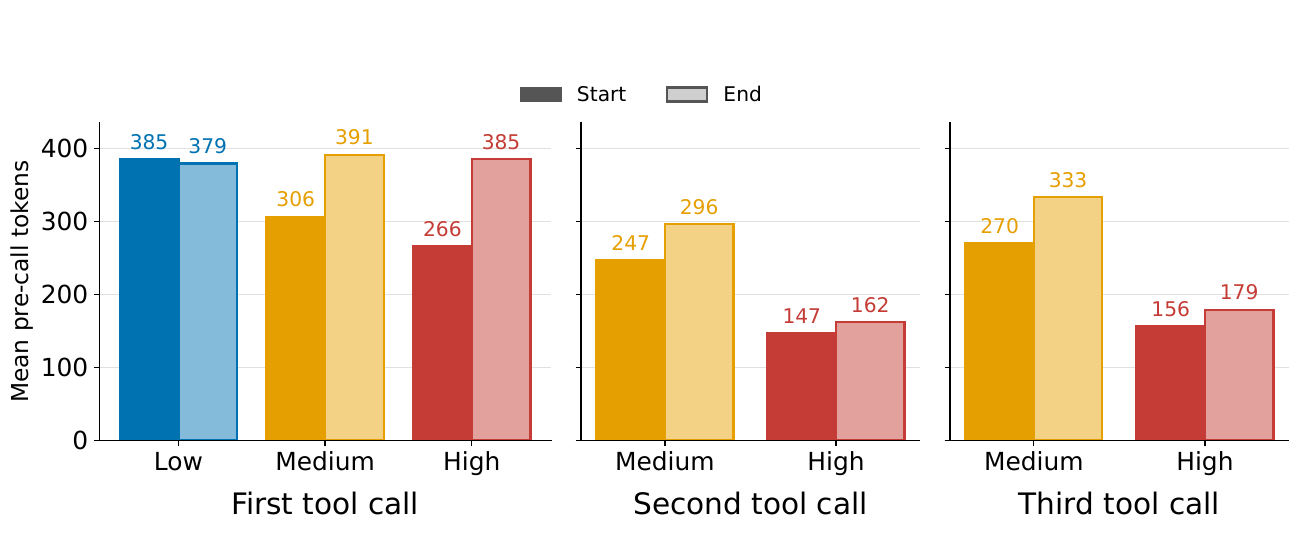
This motivated our hypothesis that the reasoning before a call helps the model plan what to ask and how to use the result. During RL, the remaining tool-using rollouts in Medium and High show longer pre-call reasoning at each of the first three calls. The change is largest before the first call.
Pre-call reasoning at the start and end of RL
Which tool-use behaviors does RL retain?
Our idealized analysis considers the same question answered with or without a tool. If tool-using answers are more often correct, outcome-only RL increases the probability of starting a call. If direct answers are more often correct, that probability falls. An SFT model’s advantage in overall accuracy and in accuracy when using tools can persist under the same optimization. Section 3.4
Filtering High by average pre-call reasoning length
We use average pre-call reasoning length as a proxy for selecting demonstrations. For each High trajectory, we count the reasoning tokens immediately before each call and average over its calls. We keep whole trajectories with the highest averages, ranking Code and Zoom separately. We select direct-answer examples separately to preserve the original proportions.
LF25 retains 320 of the 2,000 High demonstrations, accounting for about 25% of the assistant tokens supervised in one High epoch. LF50 retains 720 demonstrations and about 50% of those tokens. We train for four epochs on LF25, two on LF50 and one on High. This gives all three models roughly the same total SFT supervision before the same RL procedure.
Length filtering improves post-RL accuracy
With tools available, LF25 improves over the original High on all five benchmarks. Pooled over 6,431 questions, accuracy rises from 66.24% to 69.75%. The largest gain is on CharXiv, where accuracy rises from 31.40% to 38.40%. The gain column compares LF25 with High in percentage points.
| Benchmark | High | LF50 | LF25 | Gain (pp) |
|---|---|---|---|---|
| V*Bench | 84.29 | 84.82 | 86.91 | +2.62 |
| ChartQA | 85.48 | 85.36 | 87.72 | +2.24 |
| MathVista | 65.10 | 67.70 | 68.90 | +3.80 |
| WeMath | 57.30 | 58.79 | 60.57 | +3.27 |
| CharXiv | 31.40 | 37.20 | 38.40 | +7.00 |
| Overall | 66.24 | 67.92 | 69.75 | +3.51 |
When the model calls a tool, does it reach the right answer?
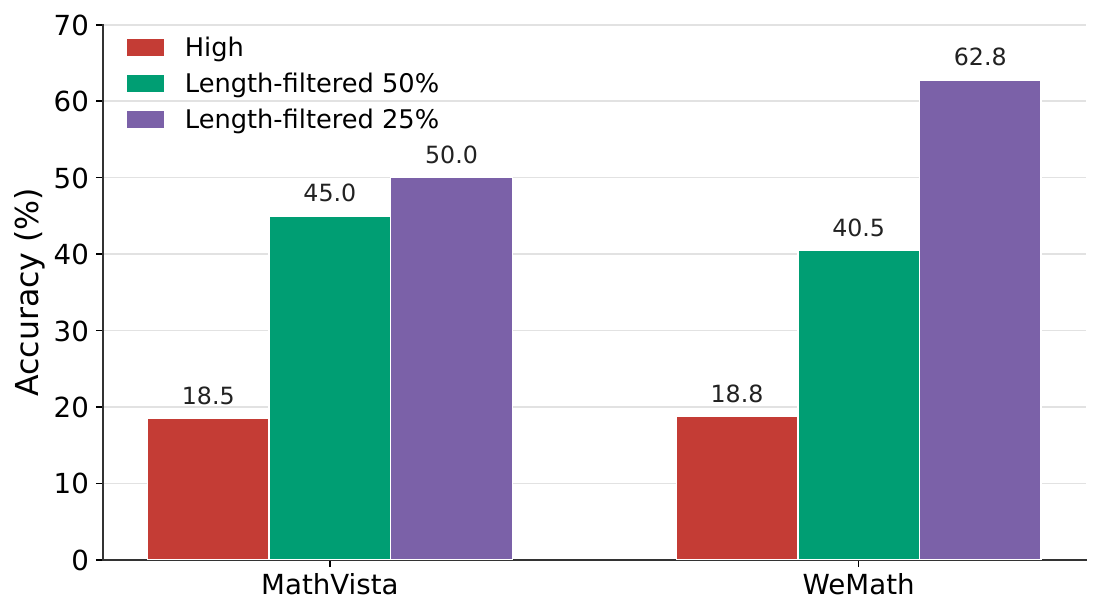
On MathVista and WeMath, a larger share of LF25’s tool-using responses end in a correct answer. On WeMath, that share rises from 18.8% with High to 62.8% with LF25. Each model chooses which questions to use tools on, so these rates describe the calls each model actually made.
Accuracy when a tool is used
How often a tool is used
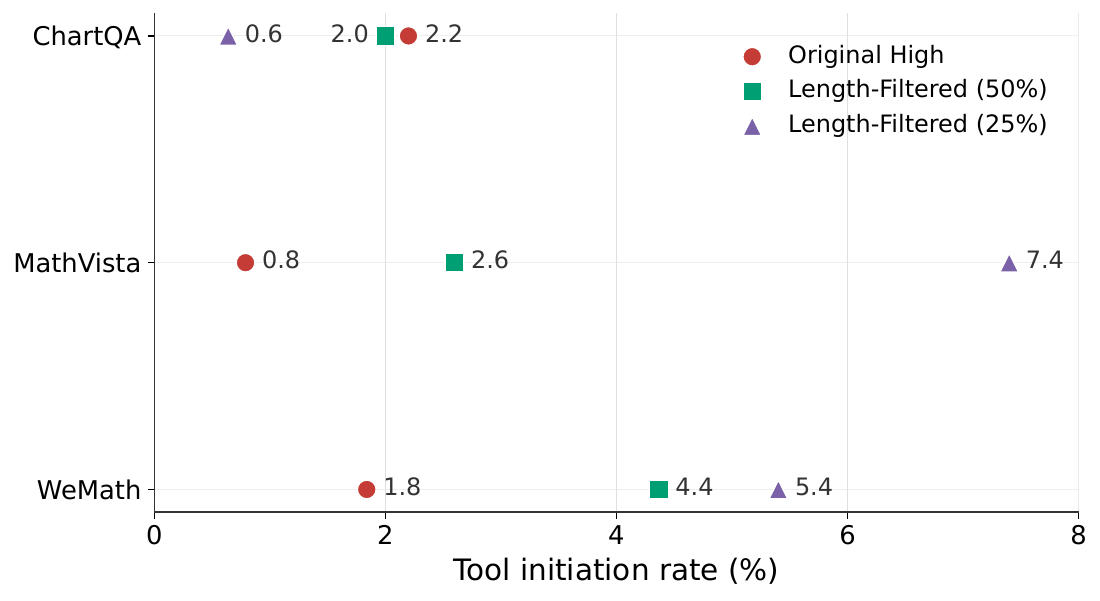
Tool initiation changes in different directions. LF25 uses tools more often on MathVista and WeMath, but on ChartQA initiation falls from 2.2% to 0.6% while final-answer accuracy improves.
Ablations and analysis
Each comparison reports post-RL accuracy with tools available. Overall accuracy pools all 6,431 questions across the five benchmarks. Table 2 in the paper
Can random selection recover the LF25 gain?
Random25 samples whole High demonstrations at random, matching LF25’s example counts and supervised-token budgets for Code, Zoom and direct answers. Matched-Random25 also approximates LF25’s mix of data sources, tool types, call depths and trajectory lengths.
| Benchmark | Random25 | Matched- | LF25 |
|---|---|---|---|
| V*Bench | 81.68 | 85.34 | 86.91 |
| ChartQA | 82.20 | 87.16 | 87.72 |
| MathVista | 66.90 | 67.40 | 68.90 |
| WeMath | 60.34 | 57.14 | 60.57 |
| CharXiv | 35.80 | 38.80 | 38.40 |
| Overall | 66.67 | 68.39 | 69.75 |
Matching raises pooled accuracy from 66.67% to 68.39%. LF25 still leads by 1.36 percentage points overall and scores higher on four of the five benchmarks. CharXiv is the exception: Matched-Random25 scores 38.80% and LF25 scores 38.40%.
Would selecting the longest reasoning traces work as well?
Total-Reasoning25 ranks demonstrations by the total number of reasoning tokens across all calls and the final response. LF25 ranks them by the average number of reasoning tokens immediately before each call. Both retain about 25% of High’s supervised tokens per epoch.
| Benchmark | Total- | LF25 |
|---|---|---|
| V*Bench | 76.44 | 86.91 |
| ChartQA | 83.56 | 87.72 |
| MathVista | 66.20 | 68.90 |
| WeMath | 54.57 | 60.57 |
| CharXiv | 34.30 | 38.40 |
| Overall | 65.15 | 69.75 |
LF25 scores higher on all five benchmarks, with a pooled advantage of 4.60 percentage points. A trace can be long because it makes many calls, even when it gives little justification for any one of them. Averaging over calls makes the selection sensitive to how much reasoning precedes each decision.
What happens when we shorten pre-call reasoning on the same examples?
We removed middle sentences from LF50’s pre-call reasoning, keeping roughly half its tokens. The questions, tool calls, arguments, observations and final answers stayed the same. Four epochs on LF50-Truncated and two on intact LF50 gave comparable cumulative exposure to pre-call tokens.
| Benchmark | LF50- | LF50 |
|---|---|---|
| V*Bench | 75.92 | 84.82 |
| ChartQA | 84.32 | 85.36 |
| MathVista | 63.90 | 67.70 |
| WeMath | 58.05 | 58.79 |
| CharXiv | 33.30 | 37.20 |
| Overall | 65.85 | 67.92 |
Truncation lowers accuracy on all five benchmarks. Pooled accuracy falls from 67.92% to 65.85%, a drop of 2.07 percentage points. This suggests that the intermediate steps connecting the evidence to the next tool call are part of what the model learns.
What the demonstrations teach
The three controls point to the reasoning that connects the available evidence to the next tool call. Selecting for longer average pre-call reasoning improves final-answer accuracy and the success of the calls the model retains. How often the model calls a tool still depends on the task.
Robustness across seeds, training duration and model backbone
| Comparison | High | LF25 |
|---|---|---|
| Qwen2.5-VL-7B · 32 updates, three seeds | 67.47 ± 1.08 | 69.58 ± 0.19 |
| Qwen2.5-VL-7B · 64 updates | 66.13 | 69.35 |
| Qwen3.5-4B · 32 updates | 72.67 | 74.35 |
The three-seed result gives the mean and sample standard deviation. Each training and evaluation run used two NVIDIA H200 GPUs.
Citation
@misc{hu2026prior,
  title = {{PRIOR}: Pre-Call Reasoning in SFT and Its Influence on Tool-Use Retention under RL},
  author = {Kaiwen Hu and Hyunin Lee and Joseph Suh and Serina Chang and Shuai Shao and Yong Zhang and Namyong Park and Xiaoqiang Luo and Luke Simon and Somayeh Sojoudi},
  year = {2026},
  eprint = {2611.33648},
  archivePrefix = {arXiv},
  primaryClass = {cs.LG},
  url = {https://arxiv.org/abs/2611.33648}
}